The Sideline Cup HolderBy Steadi Labs

Three yards off the touchline, in the grass

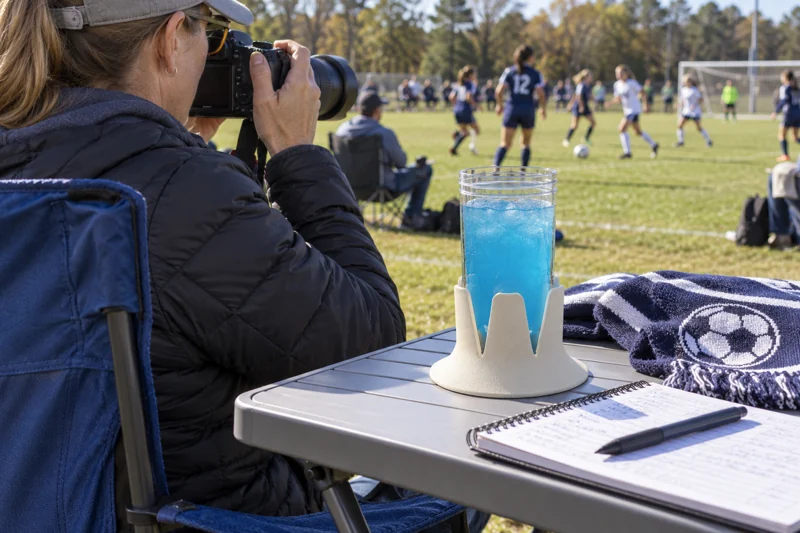
The sideline has furniture. None of it is yours.

A club bench runs $465 to $1,980. The shelter over it is $5,500 to $7,000, and it carries one line that settles the whole argument: “Note: seating products are not included.”

The entire portable-seating range a club can order is three items — a shade, a bench and a $37 three-legged stool. Not one of them holds a drink. And the playing rules put you three yards back from the touchline, on the opposite side of the field from your kid’s bench.

4.9 average · 121 reviews

See the packs

from $14.95 · free shipping on every order

Ships from Orange, California. 90 days to change your mind, used is fine.

A glass soda bottle standing in a charcoal Steadi on a weathered wooden table outdoors, mown grass and trees behind it.
Cleat Black, on a weathered outdoor table. Twelve colours in all.

Read this before anything else

Nobody forgot the parents. There was never anything out there to add it to.

Somebody spent real money on that field. Goals, nets, a bench, a shelter, a mowing height and a drainage grade. Every one of those decisions was made by a competent person working to a budget, and not one of them was ever about you.

Kwik Goal supplies benches and shelters to a very large number of American clubs. This is its entire portable-seating range, at its own published prices — every product a club can buy to sit somebody down.

Coach’s Seat

$37.00

three legs, 3 lbs

Seventeen inches high, woven fabric, collapsible steel. The catalogue “recommend[s] this seat to both spectators and coaching staff.” It is the only thing in the range aimed at you, and it is a stool.

Kwik Bench Shade

$77.00

a cover, nothing else

It goes over a bench. It is shade. There is no surface in it.

6-Seat Kwik Bench

$190.00

a plank for the squad

The full-size Soccer Bench is $465.00 to $1,980.00 — “a 10″ W plank with a clear anodized finish,” all-aluminium, in 6-, 15- and 21-foot lengths.

Or on what you brought

$14.95

no ground required

A 5.2″ moulded base, about 3.6 ounces, that the drink stands in. It goes on the plank, the cooler lid, the tailgate or the folding table — and lifts straight back off.

Three items, and not a drink surface among them. Bison Inc. catalogues the same object in the same words: a “Player bench without backrest, fixed or portable.” A club can spend seven thousand dollars on the sideline and the manufacturer will still tell it, in writing, that seating is not included.

And you are not standing where the bench is. St. Louis Youth Soccer’s playing rules state that “Spectators must remain at least 3 yards from the touchline” and must “remain on the opposite side of the field from their team.” Michigan Youth Soccer confines the coach’s box to four feet from the touchline, coaches only. The bench is across the field and it is for the kids. You are three yards back from a painted line, in the grass, holding everything.

And that strip was graded to send water at you. Cornell’s sports field management program calls the raised middle the crown: soccer fields built of native soil “typically are built with a minimum of 1½ % slope and should never be flat,” and football fields “should have at least a 1-2% slope.” The crown exists to move surface water off the playing surface, which means toward the touchlines. Be honest about the size of it — a 1.5 per cent grade drops about eight hundredths of an inch across a five-inch footprint, and that tilt on its own is not what puts a coffee over. What it tells you is what the strip is: the wet end, the soft end, and the one part of the whole facility nobody built anything on.

Sources: kwikgoal.com · bisoninc.com · slysa.org · michigansoccer.com · safesportsfields.cals.cornell.edu. Published prices, playing rules and field-management guidance, fetched 4 September 2026.


The tell that this is real

The one product ever invented for this is banned by every turf rulebook we read.

  • St. Mary’s County, Maryland, Synthetic Turf Rules and Regulations: “No stakes, posts, tripods or poles of any kind may be driven into the turf surface.”
  • Central Park of Morris County’s Artificial Turf Field Rules: “NO stakes, post, poles, or markers of any kind may be driven into the turf.”
  • Both documents go well past stakes. St. Mary’s: “Tents, canopies chairs, or shade structures are prohibited.” Morris County: “Morris County Park Commission approved chairs only. The legs may puncture the turf.”
  • St. Mary’s also bars “Wheeled devices, including but not limited to motorized vehicles, bikes, wagons, inline skates, scooters, and skateboards” from the turf surface, which takes the wagon out of the argument on those fields.
  • Even the drink is legislated. Morris County: “Only water in non-breakable containers is permitted. No glass containers or aluminum cans.” St. Mary’s: “No flavored drinks (soda, juice, sports drinks including Gatorade and other similar brands, etc.) are allowed. Only water is permitted.”

The ground stake is the only product ever designed for this exact problem — a spike you push into the dirt with a ring on top. On a synthetic field it is against the rules, and not out of fussiness. A synthetic field is a warranted carpet over an engineered stone base, and a puncture is a warranty conversation the district only has to have once.

Read the two rulebooks together and the loop closes on itself. They steer you toward exactly one container — a tall bottle of water — and then forbid the short, wide aluminium can that every cup holder ever made was drawn around.

And the field is not a side table in August. Penn State’s Center for Sports Surface Research puts the highest synthetic-turf surface temperature published in a research paper at 200°F, on a 98°F day in Provo, Utah, and records 175°F in central Pennsylvania. Natural grass it gives as “Commonly 75° to 95° F”.

This page is not going to tell you what your complex allows. Every field writes its own list, the sign at the gate is the authority on the day, and we would rather you read yours than take our word for it.

Sources: stmaryscountymd.gov · morrisparks.net · plantscience.psu.edu. Published rules and research, fetched 4 September 2026.

Does it actually work

One take, one bump, no cuts.

Somebody drops down beside a full can and the drink comes back level. The base is 5.2 inches across, so the whole thing has to lean a long way before the drink clears the edge of its own support.

Filmed on a couch cushion, in a living room. Not a field, not a plank, not turf — and we are not going to caption it as one. It is the honest footage we have, on a soft uneven surface, which is the harder case rather than the flattering one.

A full can standing in a white Steadi on a couch cushion, a living room behind it.
Real footage, one take, no cuts.

What it actually does

It moves the edge the drink would have to travel over.

A 40 oz Quencher stands on a circle Stanley publishes at 3.1 inches across. That is 1.55 inches from the centre of the drink to the edge of its own support. Set into this base, that edge is 2.6 inches out.

The drink’s centre of mass now has to travel two-thirds again as far sideways before it clears the footprint holding it up, so tipping takes a bigger tilt than it does on the cup’s own bottom. That is the entire mechanism. There is nothing else in it, and nothing that needs to be true about the surface underneath except that it is flat.

The tack of the moulded TPU is the second half. It resists sliding on a smooth aluminium plank, a cooler lid or a painted tailgate — which is what a hard sideline surface does to a drink somebody nudges.

Macro of the flared base and the moulded STEADI mark.
The flare is the mechanism. 5.2 inches across, 2.8 inches tall.

The object

One piece of moulded TPU. Six fins. Nothing to snap off in a bag.

A can sliding down into the six fins of the Steadi.
Cans and bottles slide on over the top. Cups and tumblers drop in through the fins.
  • 5.2″ base — fixed. There is one size and it does not vary, so nothing about this depends on choosing correctly.
  • 2.8″ tall, and 1.64″ across the opening at rest.
  • Six fins flexing from 0.92″ out to 3.15″. That is the whole fit range, and the top of it is the number to check against your own cup.
  • About 3.6 oz. Shore 85A thermoplastic polyurethane, injection moulded in one piece — no hinge, no clip, no spring, no hardware, nothing to lose in the grass at the end of a game.
  • 100% BPA free, and dishwasher safe on the top rack, which matters more here than most places because it is going to live in a bag with cleats.

The number that decides it

Your Stanley is not too fat. It is too tall.

The sideline folklore says a 40 oz Quencher fits nothing because it is wide. Stanley’s own product page says otherwise: the 40 oz is listed at a 3.1″ base diameter and the 30 oz at 3.15″. The bigger tumbler has the narrower base.

The problem is height. Ball Corporation’s manufacturing drawing for the industry-standard twelve-ounce can gives a body outside diameter of 2.600 ± .008″ and a flanged height of 4.812″. That is the shape every armrest sleeve and car console was drawn around: 2.6 inches wide, under five tall, heaviest at the bottom. A 40 oz tumbler stands about a foot tall on a 3.1-inch footprint. You have taken the mass a cup holder was built for and stacked it twice as high.

And the sleeve on your chair is not a socket. GCI Outdoor says its Freestyle Rocker holder “fits most standard cans, bottles, or insulated tumblers.” Big Agnes says its clip-on is “sized to fit a wide range of cups, bottles, and cans.” Neither page publishes an inside diameter or a depth, and we could not find a portable-chair maker that does. ASTM F1858, the standard covering outdoor multipositional chairs, is a stability and structural-performance document; we could find nothing anywhere specifying the dimensions of a beverage holder on a portable chair. There is no number for one to be out of compliance with, which is exactly why nobody prints one. A fabric sleeve does not have a diameter. It has a sag.

So here is ours, and it is a hard edge rather than a sag: the fins top out at 3.15 inches. A 30 oz Quencher at a published 3.15″ is at the very top of the range — worth checking at the kitchen counter tonight instead of guessing at the field on Saturday.

Handled mugs and stemmed glasses do not seat. A handle reaches into the bottom inch and fouls a fin; a stem gives the fins nothing to hold. Both are a straight no, and if the thing you carry to the field is a handled travel mug, this is not for you.

Search by container

Every width below comes from a published specification, not from us. Where a spec is uncertain, the answer says so.

Or the width across the bottom

A width across the bottom of the cup, in inches.

A row of cans and bottles the opening accepts.
Cans, tallboys and bottles, all inside the fin range.

Settle it tonight, at the counter

A standard sticky note is three inches square. Stand the cup on one and look at the base, not the rim. If the bottom sits inside the paper, it seats.

Anything that overhangs, or anything borderline — hello@steadilabs.com reaches a person, and the answer will be honest either way, including a no.

Sources: stanley1913.com · cansource.com (Ball Corporation manufacturing drawing) · gcioutdoor.com · bigagnes.com · astm.org. Published specifications, fetched 4 September 2026.

Where it earns its place

The hard surfaces a Saturday is actually full of.

The aluminium plank at the field that has bleachers. The cooler lid on the morning it is not holding the snack bin. The tailgate. The folding table under the canopy. The wagon’s fold-out table, parked. The concrete apron by the dugout, and the kerb beside the car, where half of half-time happens anyway.

On deep grass it does what grass allows. Sports Field Management lists tolerated mowing heights of 1.5 to 3 inches for Kentucky bluegrass and tall fescue, and the spectator strip outside the touchline is generally not maintained to pitch spec. A wide base standing on two inches of leaf blade is still standing on springs. It is better out there than the cup’s own bottom is; it is not a table, and this page is not going to call it one.

And set it down before the wagon moves. This is for a wagon that is parked, a tailgate that is dropped and a vehicle that is stopped. Never in a moving vehicle, never on a wagon being pulled, never on a boat under way — performance on a surface in motion is not a claim this product makes anywhere.

Twelve colours, one per drink, which is the fastest way to stop four families arguing about whose water bottle is whose at half-time.

Source: sportsfieldmanagement.org, Guide to International Soccer Pitch Maintenance. Fetched 4 September 2026.


What the sideline kit costs

Everything else needs ground you may spike, or a tube to bite.

Prices and requirements were looked up on 4 September 2026, not estimated. Every figure in the last column is the seller’s own published requirement or the field’s own published rule.

The productPriceWhat it asks of the sideline
The sleeve already on your chairComes with the chairNeither GCI Outdoor nor Big Agnes publishes an inside diameter or a depth for one. The sleeve is fabric, the chair arm under it flexes every time you push down to stand up, and there is no dimensional standard for either of them to meet.
Ground stake drink holderVariesGround you are permitted to drive a spike into. Two published synthetic-turf rulebooks forbid stakes, posts, tripods and poles outright.
Big Agnes Camp Chair Drink Holder$17.46, from $24.95A tube to clip to. Neoprene, with “two clips for securing to chairs, tents, belts, and straps.” No diameter or depth published.
Kwik Goal Coach’s Seat$37.00Nothing — it is a seat, not a drink surface. 17 inches high, 3 lbs, three legs, woven fabric.
WonderFold Parent Console$59.95A WonderFold wagon handle to velcro to, and a complex that lets the wagon on. 5.75″ deep holders on the 4-seater console, 6″ on the 2-seater.
Coleman 316 Series hard cooler$109.99 (120-quart)That you own the cooler, that its lid is free, and that your cup is inside Coleman’s own cap — “each holds up to 30 oz. tumbler.”
The Sideline Cup Holder$14.95 · four for $39.95, $9.99 eachA flat surface under it. The plank, the lid, the tailgate or the folding table is enough.

Three honest concessions, because two of these genuinely work and one of them may already be in the back of your car.

If your chair’s holder actually fits your cup, use your chair’s holder. Nothing beats a socket that already works, and nothing here improves on one. A cooler with molded lid holders is real support — a rigid recess on a heavy object that is not going anywhere, and if you own one and your cup fits it, that is the best thing on your sideline. A wagon console’s walls are genuine support too: WonderFold publishes 5.75 to 6 inches of depth, which is more wall than we have, and six inches around a tall tumbler is a real answer.

Two caveats on the cooler, one of them from a competitor. Coleman’s own spec caps its lid holders at a 30 oz tumbler, so a 40 oz is outside it — their number, not ours. And Yeti deliberately leaves lid holders off the Tundra; a reviewer explaining why writes that “At less than an inch deep, those lid cupholders are not going to prevent a drink from being spilled and only allow a single diameter cup or can to fit.” Both things are true at once: a shallow moulded ring is real support, and it is not a restraint. Neither are we.

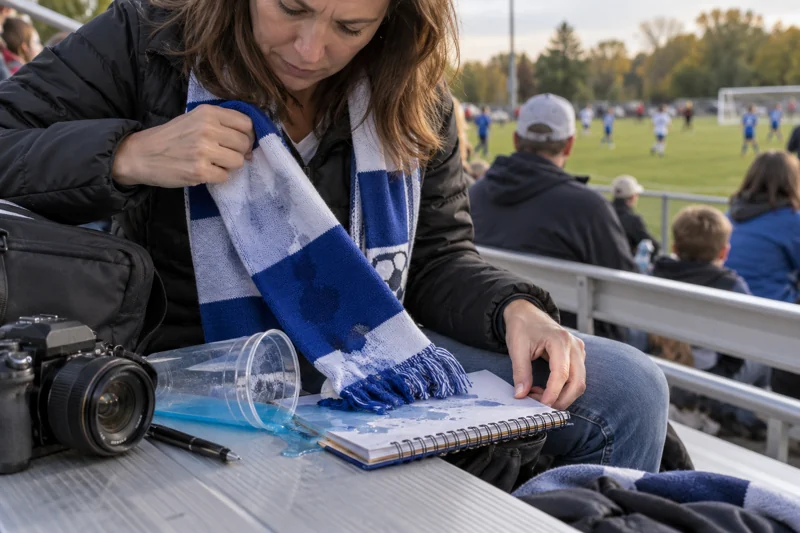
What is left is most of the day. The Saturday the cooler lid is holding the snack bin. The field with no bleachers and no tables. The chair whose sleeve your tumbler balances on top of instead of sitting down into. Standing at the fence with no chair at all, three yards back, holding everything.

Sources: gcioutdoor.com · bigagnes.com · kwikgoal.com · wonderfold.com · fishermans-marine.com, carrying Coleman’s own product copy because coleman.com returned HTTP 403 · treelinereview.com · stmaryscountymd.gov · morrisparks.net. Prices and specifications fetched 4 September 2026 and current as of that date. Steadi Labs is not affiliated with any of them.

Get one

How many drinks leave the house on a Saturday?

Count the drinks, not the kids. For most families that is two or four — yours, the other adult’s, and the water bottle per kid that ends up in the same bag anyway. Free shipping on all of them.

Checkout is handled by Steadi Labs — the company that makes The Sideline Cup Holder. Secure checkout at steadilabs.com. Free shipping on every order, and 90 days to change your mind, used is fine.

From people who bought one

Not one of these is from a sideline. We are not going to pretend otherwise.

Verbatim, unedited, not filtered by rating. This is a slice of one product-wide corpus — reviews of the Steadi, not of this page. Nobody in it mentions a touchline, a tournament or a travel team. The four below are here because they name the surfaces this page is claiming, and because two of them name the limits instead.

A black Steadi on a grandstand bench holding a canned drink in a glitter koozie, a spectator's leg beside it, at an outdoor race
Photograph sent in by Holly J with this review.

★★★★★

Steadi- Just what I was looking for! I purchased these to use at our annual NASCAR race this month. They delivered beyond my expectations. Our seats are metal benches with a slight slope towards the back, making it impossible to set down any type of drink. We were able to use these for a 20oz bottle with a koozie on it as well as a slim can with an insulated Brumate on it! They worked perfect, holding our drinks on the bench & on our cooler. I highly recommend for sporting fans, boaters, outdoor adventures. Thanks for making these!

Holly J · June 2026Photo from the buyerPhoto from the buyerPhoto from the buyerPhoto from the buyerPhoto from the buyerPhoto from the buyerPhoto from the buyer

★★★★☆

not as steady as I would like but it is working just fine. It does slide a little. Overall it was a good purchase.

Randee Kirschbrown · August 2026

★★★★★

They are great! They work very well in keeping the soda cans from falling over and spilling on the bed & couch when the three Beagles and one Border Collie jump on or off. They also stay steady on the little wobbly patio table outside.

Susan Ilkenhans · May 2026

★★★★☆

Expected it to take wider containers

Elizabeth Jackson · May 2026

18 more, photographed by the people who bought them

Sent in with their reviews. Tap any one to read it. Different rooms, different drinks, different colours — none of them staged by us.

The four-star is first on purpose. On ground that is graded, soft and often wet, “it does slide a little” is the honest headline, and burying it would be the easiest lie available on this page. The last one is a four-star too, and it is the fit ceiling stated by somebody who found it the hard way — which is why the number 3.15 is printed above rather than after you pay.

Read this before you buy, including the part that costs us the sale

What it will not do.

Sources: stmaryscountymd.gov and morrisparks.net published turf rules · plantscience.psu.edu surface-temperature research. Fetched 4 September 2026. Rules change, and your own complex’s posting is the authority on the day.

Ninety days

Long enough for a season, not just one Saturday.

Ninety days from delivery, used is fine. That covers a rec season, or a tournament weekend and the ordinary Saturdays either side of it, which is the only test that counts. Run it on real grass, a real plank and a real cooler lid, in real dew and real dust. If your chair’s sleeve turns out to hold your cup after all, send it back.

Who makes it

Steadi Labs. One person, in Orange, California.

The steel injection mould open in the machine, the cavity that forms the base visible.
The mould, in the machine.
Scott Rodriguez at a workbench, holding a terracotta Steadi and looking at it, with shipping boxes behind him.
Scott, who makes them.

Scott Rodriguez made the first one after a full drink went over on a soft cushion with three kids under three in the house. It was built for spills at home, not for fields.

Nobody standing on a touchline asked for this page. It exists because a wide base does the same thing on an aluminium plank that it does on a couch cushion, and because everything it does not do out on the grass is written above rather than left out.

This is not a mould somebody else also sells under a different name. It is one product, made in small runs, everything within about three and a half miles of the shop.

  • Steadi Labs — veteran founded and veteran owned
  • Designed, injection moulded, picked, packed and shipped in Orange, California
  • Patent pending
  • 100% BPA free
  • 5.2 inches across the foot, about 3.6 ounces

— Scott, Steadi Labs

Asked and answered

The questions that decide it.

Does it work on grass?

It works on grass the way anything works on grass. The spectator strip is generally not mown to pitch spec, so a wide base out there is standing on two inches of leaf blade — better than the cup’s own bottom, not a table. Where it genuinely earns its place is the hard surfaces the day is full of: the plank, the cooler lid, the tailgate, the folding table under the canopy.

Does my 40 oz Stanley fit?

Stanley publishes a 3.1″ base for the 40 oz and 3.15″ for the 30 oz. Both are inside the fin range and the 30 oz sits at the very top of it. Stand your own cup on a sticky note tonight and look at the base rather than the rim.

Can I clip it to the chair?

No. It clips to nothing, straps to nothing and suctions to nothing. It needs a flat surface under the whole 5.2-inch base, and a folding-chair arm is nowhere near that wide.

Are we allowed to use it on a turf field?

That is your complex’s call and not ours. The rulebooks we read forbid driving stakes, posts and poles into the surface, and this is not one — it stands on top and lifts off, leaving nothing behind. But some of those same documents also restrict chairs, canopies, wagons and even what is in the bottle, so read the sign at your gate rather than taking our word for it.

Will a soccer ball knock it over?

A ball at speed is a direct hit, and it can. What it resists is the ordinary stuff that actually puts drinks over: a chair leg shifting, a gust off the field, somebody standing up off the plank beside it.

Do I need one per kid?

One per drink is the honest answer, and the drinks outnumber the kids. It is not fixed to any chair, so it moves with whoever is holding the cup — but most families find it simpler to leave one in each chair bag than to hunt for it at half-time.

Is it dishwasher safe?

Yes, top rack.

Still deciding

$14.95, against the tumbler it is standing under.

A named retailer lists the 40 oz Quencher at $45.00. This costs a third of that. We are not going to argue it on price, though — Big Agnes will sell you a clip-on neoprene sleeve for $17.46 and it is a real product. The difference is what each one needs from the ground: a clip needs a tube to bite, a stake needs dirt you are permitted to spike, and on most Saturdays you have neither.

If your chair’s holder fits your cup, keep your money. If your cooler lid is free every week and your cup sits in it, keep your money. If the answer to “where do I put this” is still “the grass, next to the chair leg” — that is the whole reason this page exists.

Source: halfmoonoutfitters.com listing for the Stanley Quencher H2.0 40 oz, and bigagnes.com. Fetched 4 September 2026.

Every decision that put your coffee in the grass was correct.

The crown is there so the field drains. The mowing height is there so the ball rolls. The no-stakes rule is there because a synthetic field is a warranted surface over an engineered base and the district paid for it once. The bench is ten inches of anodised plank because that seats a squad for under two thousand dollars and outlives three coaches. The shelter costs seven thousand and says seating is not included.

Not one of those people was ever asked about a parent with a coffee, standing three yards off a painted line. Nobody is going to add it, because there is nothing out there to add it to. You just do not have to keep setting the cup down in the grass.

See the packs

from $14.95 — free shipping on every order · 90-day guarantee, used is fine · Made in Orange, California