The sideline file
Every surface at a youth sports game was built for something other than holding a drink upright — the field for drainage, the turf for durability, the chair for folding flat, the bleacher for bearing a crowd's weight. None of it was ever designed around a cup. Here's the physics of why a drink goes over out there, what parents already try, and what it actually takes to hold one steady.
Natural grass fields aren't flat by accident of neglect — they're built that way on purpose. Turf-management guidance from groups like STMA and Cornell puts field grading at roughly 0.5% up to 1 or 2%, a crown or slope engineered so rain sheds toward the sidelines instead of pooling at midfield. That's the exact strip of ground where the chairs go.
A drink set on that strip isn't standing on flat ground. It's standing on grass blades and thatch, over soil that's already tilted by design, often still wet with dew for an 8 a.m. kickoff. A tall, narrow-based tumbler starts with a small, soft, uneven contact patch — the slope and the wet grass just make it worse. The nudge from a cleat, a chair leg working deeper into the turf, or a stray warm-up ball is what actually tips it over, but the ground did most of the work before that nudge ever landed.
Artificial turf solves the slope — it's flat — but nothing can be staked into it, and it runs hot. Surface-temperature research out of Penn State has measured synthetic turf running 35 to 55°F hotter than natural grass under the same sun, and other published readings have put some turf surfaces above the roughly 118°F skin-burn threshold for hours on a warm afternoon.
That's why anything that depends on being driven into the ground doesn't work on turf at all, and why a drink that does go over there comes back up ringed in crumb rubber, the black infill that clings to anything wet. By an afternoon game, the same flat, seemingly easy surface is instead the hottest, least forgiving one at the complex.
Every sideline quad chair ships with a mesh sleeve sewn into the armrest, sized for a 12 oz can from before insulated tumblers took over coolers and diaper bags. A 30 or 40 oz tumbler doesn't drop into it at all.
Even when a drink does fit, the sleeve has no rigid floor — it's fabric, tensioned by the armrest frame, and it collapses the instant the chair does. Chair-testing coverage from OutdoorGearLab has found that some mesh holders won't keep a drink upright the moment the sitter's own weight leaves the seat — exactly the moment a chair rocks on uneven ground with nobody in it, which is snack duty, halftime, anyone standing up to cheer. At the final whistle, a drink left riding in the sleeve goes down with the chair when it folds one-handed.
Where a field has bleachers, the seating itself is the obstacle. Standard aluminum bleachers are built from nominal 10-inch seat planks on a 24-inch row depth with an 8-inch rise between rows — dimensions sized for sitting and walking, with no cup holder anywhere in the design.
A bottle set on a 10-inch plank has nowhere secure to sit. It rolls with the first crowd stomp, and the gap between the seat plank and the footboard below is wide enough to drop a bottle straight through to the row underneath. The only flat surface available is also the surface everyone's shoes are on.
None of this is a new problem, and the fixes people reach for first tend to solve an adjacent problem instead of this one.
Ground stakes and beverage spikes only work where a spike can actually be driven into soil — turf, bleachers, and any paved lot rule them out entirely, and even on grass, most roundups of these products still list wind and uneven ground as the acknowledged weak point.
Cup-holder adapters built for oversized tumblers are a real category — Popular Mechanics runs a whole roundup of them — but they solve a car's center console, not a folding chair on grass, and none of them touch the sideline at all.
Clamp-on cup holders for the chair only work if the clamp happens to match the exact armrest tube, and even then they're solving the same can-era sizing problem as the sleeve they're bolted onto — a 40 oz tumbler still doesn't fit inside most of them.
And the wagon's own fold-out table holder is fine while the wagon's parked at the pop-up, but it's a shallow mesh sleeve just like the chair's, and it jostles a drink loose the moment the wagon rolls over grass to get there. The drink still needs somewhere to actually sit once the game starts.
Everything above points at the same requirement: whatever holds the drink can't depend on the ground being flat, can't depend on matching one specific chair or wagon, and can't be sized for a can that stopped being the default drink a decade ago.
That means a footprint wide enough to spread across grass, turf, or a bleacher plank instead of balancing on one point of contact, so it doesn't need the surface underneath to cooperate. And it means grip low on the drink itself, at the bottom inch of the can, bottle, or tumbler, rather than grip that depends on a rigid sleeve or a level floor.
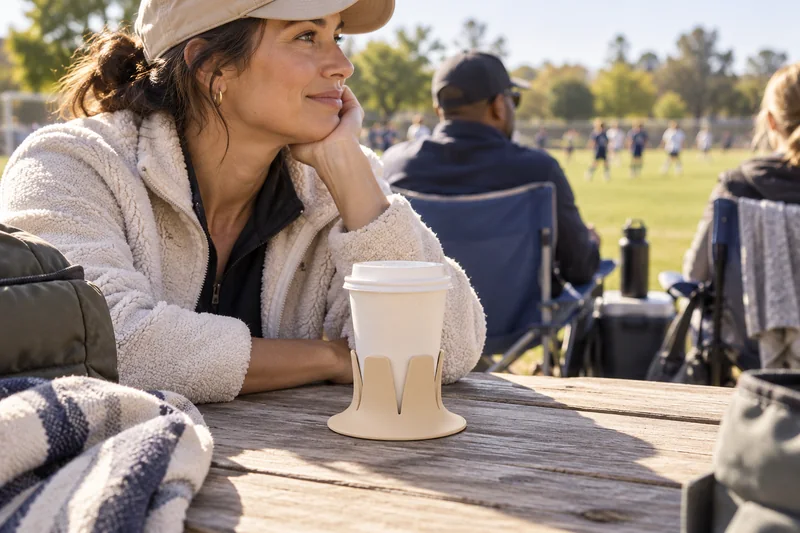
That's the mechanism behind a wide, flexible base with fins that close around the lower inch of whatever's set into it: a base of 2 to 3 inches settles in fully, and the fins flex to seat bases as wide as 3.15 inches too, a snug fit for cups like the Stanley 30 oz FlowState Quencher, whose base sits right at that edge. It doesn't ask the grass to be level, the turf to be cool, or the chair's own holder to finally fit something bigger than a can. Bumped by a cleat or a rocking chair leg, it settles back down instead of going over.
None of that requires a spot on the field to be flat, staked, or reserved — just a base that holds steady wherever the chair happens to land this Saturday. Steadi Labs molds it in small runs in Orange, California, and ships every order free.
Bring one home from steadilabs.com →Buying happens at steadilabs.com — the company that molds it.